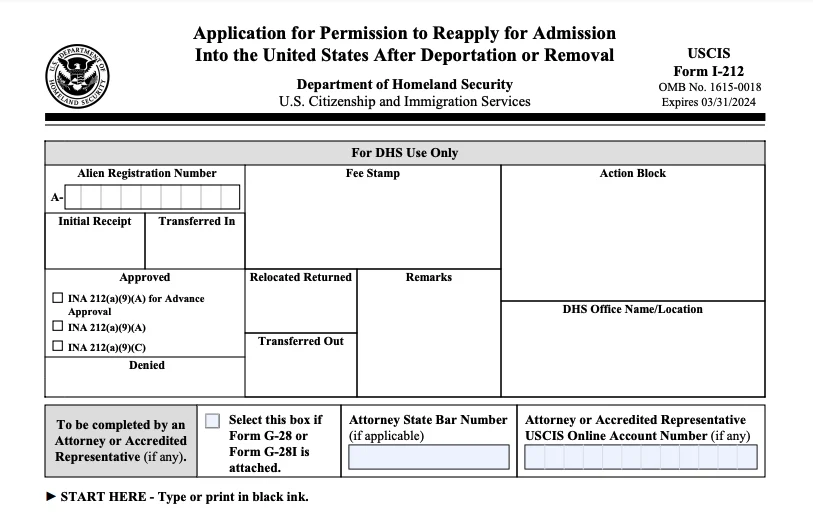
Form I-212 is the USCIS application commonly called the “permission to reapply” or the “212 waiver.” It is used by people who were previously deported, removed, or otherwise ordered excluded and now seek DHS permission to reapply for admission to the United States after that removal.
The form’s core purpose is to ask immigration authorities to exercise discretion and allow the applicant to reapply for admission despite prior immigration violations or a removal order, but an approved I-212 does not itself grant a visa or admission. If you or a family member were previously removed, this guide explains when a 212 waiver is required and how to prepare a strong application.
Legal Framework
Form I-212 is based primarily on the Immigration and Nationality Act (INA), particularly the inadmissibility provisions found in Sections 212(a)(9)(A) and 212(a)(9)(C). These sections address the consequences of prior removal orders, unlawful presence, and unlawful reentry after deportation.
Individuals who attempt to enter or re-enter the United States without inspection after removal, or after accruing significant periods of unlawful presence, may require DHS permission before seeking admission again. For many applicants, the key issue is not simply whether a reentry bar has expired, but whether they must first obtain permission to reapply for admission through Form I-212.

The 212 Waiver (Form I-212) Explained
The 212 waiver is a discretionary request for permission to reapply for admission to the United States after deportation or removal. If approved, DHS grants consent for the applicant to continue pursuing available immigration benefits, such as an immigrant visa or adjustment of status.
However, approval of Form I-212 is not the same as admission. It merely removes one legal obstacle by granting consent to reapply. Applicants must still satisfy all other immigration requirements, including obtaining any required visas, waivers, or approvals before they can be admitted into the country.
How to File Form I-212
The first step is determining the correct filing authority. Depending on the circumstances, the application may be submitted to USCIS, Customs and Border Protection (CBP), or through a U.S. consulate as part of consular processing.
Applicants should complete the form carefully and provide accurate details regarding their immigration history, including prior removals, unlawful presence, A-numbers, and any prior immigration proceedings. Any inaccuracies or omissions can create additional immigration problems and potentially lead to denial.
A well-prepared application should also include a detailed personal statement explaining the circumstances of the prior removal, the applicant’s current situation, family ties, rehabilitation efforts, and reasons for seeking lawful reentry.
Finally, applicants should keep copies of everything submitted and use a secure filing method that provides proof of delivery or submission.
Where to Submit Form I-212 and Filing Fees
The filing location for Form I-212 depends on the applicant’s specific immigration situation. Some applicants file directly with USCIS, while others file through a consular process or with CBP.
Because filing fees and submission procedures can change, applicants should always verify the most current filing instructions, payment methods, and filing addresses before submitting their application. Incorrect filing locations or outdated fees can result in delays or rejection of the application.
Form I-212 Supporting Documents Checklist
A strong Form I-212 application typically includes documentation that demonstrates both eligibility and favorable discretionary factors. Supporting evidence may include:
Copies of deportation, removal, exclusion, or reinstatement orders
Documentation showing time spent outside the United States
Proof of family relationships, including U.S. citizen or lawful permanent resident relatives
Employment records, tax returns, and evidence of financial stability
Community involvement and character reference letters
Evidence of rehabilitation or completion of counseling programs
Certified translations for any foreign-language documents
The quality and organization of supporting evidence can significantly influence the outcome of a 212 waiver application.
Positive Factors That Can Strengthen Your Application
Because Form I-212 is discretionary, immigration authorities evaluate both favorable and unfavorable factors.
Positive factors often include strong family ties to the United States, such as a U.S. citizen child, a lawful permanent resident spouse, or other close relatives. Stable employment, community service, educational achievements, and evidence of good moral character can also strengthen an application.
Applicants should also highlight rehabilitation efforts, compliance with immigration laws since removal, and any humanitarian concerns or hardships that support their request for permission to reapply for admission.

Negative Factors That Can Hurt Approval
Certain issues can negatively affect a Form I-212 application. These include criminal convictions, especially aggravated felonies, multiple immigration violations, repeated unlawful entries, or prior removals.
Immigration authorities also carefully consider public safety concerns and patterns of noncompliance with immigration laws. Applicants with complex histories should work closely with an immigration attorney to address these issues effectively.
Processing Time, Biometrics, and Decision
After filing, applicants should retain their receipt notice and monitor case updates through the appropriate agency.
Some applicants may be required to attend a biometrics appointment. Processing times vary considerably depending on the filing office, case complexity, and overall agency workload. Cases involving criminal records, multiple removals, or extensive immigration histories often take longer and may result in Requests for Evidence (RFEs).
After Approval: Reapplying for Admission
An approved Form I-212 allows the applicant to continue with the next stage of the immigration process. This may include consular processing, applying for an immigrant visa, pursuing adjustment of status, or seeking another immigration benefit.
Applicants should remember that approval does not guarantee visa issuance or admission. Consular officers and DHS officials will still evaluate all other eligibility requirements before allowing entry into the United States.
If Your Form I-212 Is Denied
A denial does not always mean the end of the process. Applicants should carefully review the reasons for denial to determine whether the issue was procedural or discretionary.
Depending on the circumstances, it may be possible to file a motion to reopen, a motion to reconsider, or submit a stronger application in the future with additional supporting evidence. Consulting an experienced immigration lawyer can help determine the best strategy moving forward.
Special Situations and Risks of Illegal Reentry
Individuals who have been removed should never attempt unlawful reentry into the United States. Illegal reentry can result in serious immigration consequences, criminal penalties, and reinstatement of prior removal orders.
A reinstated removal order can create significant obstacles for future immigration benefits and may make lawful reentry substantially more difficult. In limited emergency situations, humanitarian parole may be available, but such cases are highly fact-specific and should be discussed with qualified legal counsel.
When to Get Legal Help for Form I-212
Seeking guidance from an experienced immigration attorney early in the process can significantly improve the quality of a Form I-212 application. Legal representation is especially important for applicants with criminal histories, multiple removals, unlawful reentry issues, or other complex inadmissibility concerns.
An immigration lawyer can help identify potential obstacles, gather persuasive supporting evidence, prepare legal arguments, and ensure that the application is filed correctly.
Need Help With a Form I-212 Application?
Obtaining approval for Form I-212 requires more than completing paperwork. Because the 212 waiver is discretionary, immigration authorities review an applicant’s immigration history, family ties, current immigration status, and other positive and negative factors before granting permission to reapply for admission after deportation or removal.
At the Abbasi Immigration Law Firm, our experienced immigration lawyers help clients with Form I-212, immigrant visa matters, and other complex immigration cases. We work to build strong applications with compelling supporting evidence for individuals seeking lawful reentry and permission to reapply for admission to the United States.
Contact us today to schedule a consultation.